Showing posts with label Art. Show all posts

Sunday, 15 December 2013

Futurism. Colours. Movement.

After giving it some thought, I came up with a general idea for my visual concept, that is, to design an evening gown with a twist, in that I want it to be elegant and classy yet modern, inspired by the designs of Italian-born French couturière Elsa Schiaparelli. While conducting research regarding the mentioned designer, I found out that despite being greatly associated with the Surrealist and Dadaist movements, she was also influenced by the Futurists. That is why I decided that with regards to art, I would refer to the Futurist movement - focusing mainly on their use of colour, since that is the aspect which will be used as a source of inspiration for my design. 

Futurism was an artistic and social movement that originated in Italy in the early 20th century. It was founded by the Italian poet Filippo Tommaso Marinetti who published his Manifesto of Futurism on the front page of Le Figaro - a Parisian newspaper. The movement was mainly based in Italy, although its influences reached out also to Russia and England, with key figures of the movement including Italian artists Filippo Tommaso Marinetti, Umberto Boccioni and Giacomo Balla, and Russian artist Natalia Goncharova.

It is fascinating to note that the Futurists made use of every artistic form possible to demonstrate their beliefs: painting, sculpture, industrial design, theatre, fashion, film, literature, music, architecture and graphic design amongst others. 

Being mostly based in Italy, the main aim of the Futurist movement was to rid the country of anything old, classical and not totally new and work towards a new, modern Italy. They felt that the past culture of Italy was weighing them down as it was particularly oppressive. That is why Marinetti states in one his Manifesto that the Futurists "will free Italy from her innumerable museums which cover her like countless cemeteries" (Marinetti,1909). What the Futurists proposed instead was the introduction of modernity. They emphasized and celebrated anything related to the modern world of industry and technology - speed, youth and violence; and objects such as the car, the aeroplane and the industrial city. 

‘We declare … a new beauty, the beauty of speed. A racing motor car … is more beautiful than the Victory of Samothrace’
 (Marinetti, 1909) 

With regards to art, the Futurists incorporated elements of Neo-Impressionism and Cubism to create an original style that expressed the dynamism, energy and movement of modern life. Their art is distinctive in that most of the time they made use of a process known as divisionism, which meant that they broke light and colour down into a series of dots and geometric forms.
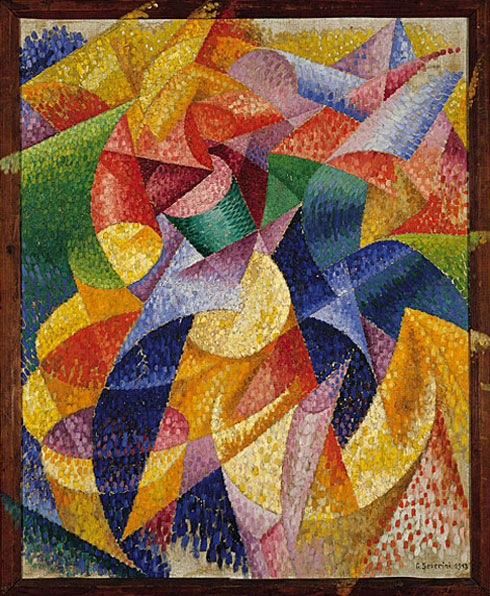
Sea = Dancer
(1914)
Gino Severini

 Abstract Speed + Sound
 (1913–1914)
Giacomo Balla

The City Rises
(1910)
Umberto Boccioni

While looking for more contemporary examples of art inspired by the futurist movement, I came across the art work (shown below) by Mark Webster. Comparing the works shown above with the one below, one can immediately notice the aggressive use of line and simple but bold colours. 

Abstract Geometric Futurist Figurative Oil Painting
Mark Webster


I will definitely be making use of a combination of these colours in my design and further enhancing the aspect of movement by including lines and shapes in subtle but effective way. 


References:

TATE - Futurism [online]. Available at <http://www.tate.org.uk/whats-on/tate-modern/exhibition/futurism> [Accessed 15th December, 2013]

The Solomon R. Guggenheim Foundation (SRGF), 2013. Collection Online - Futurism [online]. Available at <http://www.guggenheim.org/new-york/collections/collection-online/movements/195215/description> [Accessed 15th December, 2013]


Image sources: 

http://upload.wikimedia.org/wikipedia/commons/f/fe/Umberto_Boccioni_001.jpg

http://upload.wikimedia.org/wikipedia/en/1/12/GBallaArt.jpg

http://markadamwebster.com/workszoom/897562

http://www.designishistory.com/files/gimgs/32_futurism01.jpg


Sunday, 27 October 2013

Movement in Duchamp's 'Nude Descending the Staircase, No.2'

Marcel Duchamp (1887-1968) was a French-American painter and mixed media artist who is best known today as being one of the most influential figures of modern art. Despite not being in alliance with any of the movements, Duchamp was associated with and greatly influenced by Cubism, Dadaism and Surrealism. His art sought to engage the intellect and imagination of the viewer instead of just the eyes - portraying invisible worlds instead of just visible ones. His aim was to introduce the fact that art can be about ideas and not just about worldly things. Duchamp refused to give in to the rules of an established art system, and this can be seen in his works which are characterized by their humour, the variety and unconventionality of the media used and most importantly the incessant probing of the boundaries of art. It is this 'new art' which makes Marcel Duchamp one of the artists in the history of art who has had the most impact on artists many centuries later. 


Nude Descending Staircase, No.2
(1912)

Nude Descending Staircase, No.2 is one of Duchamp's paintings which caused quite a stir when it was presented since it depicted a mechanical portrayal of a subject which was once so sensual and classical. Instead of capturing the woman restricted to the confines of the bedroom, Duchamp records the entire process of the woman coming down the stairs. 

In this oil painting, one can see the influences of Cubism and Futurism. The former can seen through the deconstruction of forms and monochromatic tonality which were major characteristics of the Cubist movement. The latter is seen in the way that Duchamp doesn't immortalise a single pose or gesture, but he captures the motion and energy of the body as it moves by painting each static phase (like the Futurists who were obsessed with notions of velocity). 

Essentially, the painting is made up of abstract lines and planes, but they are assembled in such a way so as to suggest rhythm and convey the movement of the figure. The dark outlines show the contours of the body while also emphasizing the dynamics of the moving figure by acting as motion lines. There are also some accented arcs made up of dotted lines which suggest the thrusting pelvic motion. Despite being monochromatic, the use of tones and shades of the ochres and browns in the painting are also essential in depicting movement. The colour seems to be fairly darker at the upper left corner than the centre and bottom right corner of the painting. This was probably done to show the initial movement - an action which occurred previous to the ones that followed. The shaded planes also help to give depth and volume to the form. 


References:

Andrew Stafford, 2008. Making Sense of Marcel Duchamp [online]. Available at <http://www.understandingduchamp.com/> [Accessed 26th October, 2013]

Terry Riggs, 1997. TATE - Marcel Duchamp [online]. Available at <http://www.tate.org.uk/art/artists/marcel-duchamp-1036> [Accessed 26th October, 2013]

MoMa, 2013. The Collection - Marcel Duchamp [online]. Available at <http://www.moma.org/collection/browse_results.php?artistFilterInitial=&criteria=O%3AAD%3AE%3A1634&page_number=1&template_id=6&sort_order=1> [Accessed 26th October, 2013]

The Solomon R. Guggenheim Foundation (SRGF), 2013. Collection Online - Marcel Duchamp [online]. Available at <http://www.guggenheim.org/new-york/collections/collection-online/artists/bios/1174> [Accessed 26th October, 2013]

Image source: http://upload.wikimedia.org/wikipedia/en/c/c0/Duchamp_-_Nude_Descending_a_Staircase.jpg


Saturday, 26 October 2013

Movement in Muybridge's 'Horse in Motion'

Eadweard Muybridge (1830-1904) was a British photographer whose early photographic experiments laid the foundation for modern cinema, making him known today as 'the father of the motion picture'. In 1860 Muybridge developed a keen interest in photography, but it was in 1872 when he started to consider rapid motion photography after being approached by a Californian racehorse owner, Leland Stanford. It seemed that Stanford had made a bet on the issue as to whether all four feet of a horse were off the ground at the same time while trotting. His initial results did prove that Stanford was right, but it took another series of experiments (the result of which came to be known as the first ever moving picture) and his invention of the zoopraxiscope (a device which enabled him to project his silhouettes in rapid succession onto a screen) to lead the way to further develop his studies of motion and in-motion projection.  

The Horse in Motion
(1878)

The experiment mentioned previously is known as The Horse in Motion, also known as Sallie Gardner at a Gallop. It is a series of photographs shot in rapid succession - capturing what no human eye had ever seen: that a horse lifts all four hooves off the ground at one point in the action of running. This experiment was conducted after Muybridge, who was a pioneer not only of early photography but the science and study of movement as well, fabricated a special camera that would capture every sequence of his subjects' movements, frame by frame. By getting a horse to trigger the shutters of a bank fitted with twelve cameras, Muybridge was able to capture each movement in the process of the horse's galloping. When run together, the photographs produced the effect of a horse in motion. 


References:
WildFilmHistory. Eadweard Muybridge [online]. Available at <http://www.wildfilmhistory.org/person/180/Eadweard+Muybridge.html > [Accessed 26th October, 2013]

TATE - Eadweard Muybridge [online]. Available at <http://www.tate.org.uk/whats-on/tate-britain/exhibition/eadweard-muybridge> [Accessed 26th October, 2013]

MoMa, 2013. The Collection - Eadweard Muybridge [online]. Available at <http://www.moma.org/collection/browse_results.php?criteria=O%3AAD%3AE%3A4192&page_number=2&template_id=6&sort_order=1 > [Accessed 26th October, 2013]

Image source: http://upload.wikimedia.org/wikipedia/commons/7/73/The_Horse_in_Motion.jpg