Showing posts with label Film. Show all posts

Thursday, 19 December 2013

'Spectacular Spectacular' - Moulin Rouge and its costumes

Being into music, without a doubt, one of the films that I just had to watch was Moulin Rouge. I thank the heavens that I did so at the beginning of our school semester since once presented with our assignment for film, I immediately thought of this particular film and it's wonderful costumes, especially those pertaining to the main female character. That was part of the main inspiration for my concept - designing a classy yet modern evening gown.


Moulin Rouge is a 2001 Australian-American romantic pastiche-jukebox musical film directed, produced and also co-written by Baz Luhrmann. Featuring the talents of the stunning Nicole Kidman (Satine) and Ewan McGregor (Christian), it tells the story of a young English man (McGregor) who travelled to Paris in the year 1899 to become a writer and make part of Montmartre's Bohemian movement. After accidentally meeting artist Toulouse-Lautrec and his fellow performers, he helps them finish their show 'Spectacular Spectacular' in the hope of selling it to Harold Zidler, owner of the Moulin Rouge. Christian is set to meet Satine (Kidman), the star courtesan of the cabaret. At the same time, Zidler is making arrangements with the wealthy Duke of Monroth, a potential investor in the cabaret. Satine mistakes Christian for the Duke, but soon learns that Christian is just a writer - though that didn't stop them from falling in love. After a series of events the Duke soon realises that the play is a metaphor for the love triangle consisting of Christian, Satine and the Duke himself, and demands a change in ending. The Duke warns Zidler that he will have Christian killed if Satine is not his. When Zidler informs Satine that she is dying, she tells Christian that they can no longer see each other because she will be staying with the Duke. Christian becomes depressed, and on the night of the show, he sneaks back into the Moulin Rouge. Suddenly finding himself in the spotlight, Christian pretends to be an actor, and finally walks off the stage in anger, only to return as Satine begins to sing the song Christian had previously written to express their love for each other. The Duke and his bodyguards try to kill Christian, but both attempts fail. As the show ends and the curtain closes, Satine succumbs to her illness, whose last words affirm her love towards Christian. The film ends with Christian at his typewriter a year later - 1990 - writing the tale of the two lovers. 

Costume design is essential in any film, together with the script, actors and soundtrack. Though probably on a subconscious level, the costumes determine how the audience portrays the characters that wear them. Through powerful colours and sparkling accessories, the audience may come to know of the character's role in the film as being central, while being part of the background when characters are seen in less varying costumes. It is worth noting that this film won an Oscar for Best Costume Design, and it was well-deserved in my opinion seeing as the level of creativity shown by the main costume designer Catherine Martin is of extremely high level. For me, she succeeded in giving the audience a glimpse of real people and theatre characters in the 1900s while also modifying them and giving the audience a more modern view. Particular attention must be paid to the costumes worn by lead actress Nicole Kidman. In an interview with national British newspaper The Guardian, Martin says:

"With Satine, we needed to make it clear that this is the most beautiful woman in Paris. Admittedly, Nicole is already very beautiful, but she may not be everybody's idea of ideal beauty, so we needed to make it clear with the costumes' signs and symbols that that's who she was. We looked to Hollywood's glamour heroines like Marlene Dietrich, Marilyn Monroe, Greta Garbo - all sexually available to the men in the movies but emotionally very unavailable, and we looked at how that manifested itself in their clothing. Their wardrobes tended to be very graphic, unfussy, dramatic in their colour choice. We then used that." 
(Martin, 2001)

There are two particular costumes which struck me most - the first being the Red Dress, also known as the "Smoldering Temptress" Dress.
.


As one can see from the above costume designs, Satine's iconic Red Dress went through various before it arrived at the one used in the film. Made of red satin, with a corseted top that laces in the back and an intricate bustle, the dress is perhaps the most famous from the film. The colour of the dress was cleverly chosen to reflect Satine's character in the scene, primarily because it draws attention to her, and it also reflects her attempt at softening the Duke to invest in the show.

The second costume which I will probably use as a reference point in my design process is the Gothic Tower Dress. With reference to accessories, it is worth noting the necklace used in this scene.


The dress is made entirely of  black velvet, trimmed with reddish-brown fur along the train and the one shoulder. It is a pity that this detail is barely noticeable due to the minimal lighting used in the scene so as to reflect the unsettling atmosphere in the scene. The necklace worn by the actress was designed by Stefano Canturi and consisted of 1, 308 real diamonds and platinum, and was the most expensive piece of jewellery ever specifically made for a film. 

I couldn't help but add some more images of costumes from this film. To me, each one is a magnificent piece of art. 


References:

IMDb. Moulin Rouge! (2001) [online]. Available at <http://www.imdb.com/title/tt0203009/?ref_=ttfc_fc_tt> [Accessed 19th December, 2013]

Hadley Freeman, 2001. Can-can do [online]. Available at <http://www.theguardian.com/film/2001/sep/07/fashion> [Accessed 19th December, 2013]


Video Source:

https://www.youtube.com/watch?feature=player_embedded&v=MANzKbDuNw8


Image sources:

http://www.costumersguide.com/moulinrouge/ref17.jpg

http://www.costumersguide.com/moulinrouge/ref20.jpg

https://blogger.googleusercontent.com/img/b/R29vZ2xl/AVvXsEha9Jp4EWWsTMGPNFbO106WbNsGqdUVytQdkH734QJ3hMOZaybsK7E_8Ano_wJCmGF9Dfz7T3RTe-tVDyt1gjDDsGGgjPAXUQoiUunwC4Ht3y8wyOlFVt96h4WsAuC_NeM5PfPTSNJaNcKm/s400/mcx-top-movie-dresses-moulin-rouge-xln.jpg

http://www.costumersguide.com/moulinrouge/gothic5.jpg

https://blogger.googleusercontent.com/img/b/R29vZ2xl/AVvXsEh3AdpmV6oqbpblFy2gfb9Hjn34iEfzBd01E80Zau9IvlxbpS4bEkZveuvif2jHuWllA8HPzubWp16QWomDXVcpaq4dE_kyM9dzU4H4mH2vpq1jaYEHu4LjbB-yE1LbqtJ-UXSsTp1zywqL/s400/gothic2.jpg

https://blogger.googleusercontent.com/img/b/R29vZ2xl/AVvXsEiha29_OT7M-Srocdy9s0VomQFNfqo50lPBzR2Io2woCL2TiGXEm1mus0JHiWpUmsfV1_6bXPbRST9eSLTs3jSwkiEIWFcaMECb5iNMzxqNqsPUBHZR1hKmghjp3vVvQYfIWSBRgI3y-9if/s400/2013-05-07+07.17.45+pm.png

http://www.costumersguide.com/moulinrouge/black1.jpg

http://insightandout.files.wordpress.com/2011/10/moulin-rouge-nicole-kidman.png

http://www.costumersguide.com/moulinrouge/corset1.jpg

https://blogger.googleusercontent.com/img/b/R29vZ2xl/AVvXsEjxXoHLmImsHNJwFXG0AOvO53q1d8zYXttz3Fd4t3D5qf824xXFi9fQuk5vi0cvIPe2Sdyj6Ub0Hk02CidHUWXfvaYY5VdTuW0DLbictWyBAJ-zWlO5tXIiYM5MrQwgcxFryy5QwzStC_Ox/s400/2013-05-07+07.14.59+pm.png

http://bios.weddingbee.com/pics/127250/satineweddingdress1.jpg

http://www.costumersguide.com/moulinrouge/hindi9.jpg

Monday, 28 October 2013

Sherlock Holmes (2009) - The opening scene and the first fight scene

Is it the soundtrack, action or excellent acting skills that make me want to see this film over and over again? I don't know. What I do know is that Sherlock Holmes, directed by Guy Ritchie and featuring the talents of Robert Downey Jr. and Jude Law, has become one of my all-time favourite films. In this post I will be discussing the first two-and-a-half minutes of the film. 


The opening scene of the film starts with cobbled streets - a key feature in London during the 18th century - which immediately sets the scene. The track 'Discombobulate' composed for the film by Hans Zimmer begins to play which sounds dramatic yet slow, however begins to build up. The camera moves upwards in a follow shot of a horse and carriage; the sound of the clomping horse hooves momentarily dominates the soundtrack. Soon after we notice and increase in camera movement as the camera moves towards the carriage and zooms inside. This increase in speed mimics the speed of the carriage and this ultimately generates a sense of urgency and movement. After several close-up shots of the weapons being handled by two male characters, we are introduced to a man running, as though he is a suspect and the carriage is following him. Through a close-up shot, the camera then reveals that the man is the protagonist. Soon after, a voice-over is used as the leading character stands against a wall in a building as he contemplates his next moves. This attack scene is in slow motion and the music is muted. The scene then flashes forward to when he leaps out and attacks a man using the fight moves stated in the voice-over. The scene ends with the protagonist taking his attacker's hat and swiftly descending a spiral staircase.

Emphasis on movement in this scene is created through the use of music, slow motion and contrasting brisk camera movements in certain moments, and close-up shots. 


References:

IMDb. Sherlock Holmes (2009) [online]. Available at <http://www.imdb.com/title/tt0988045/> [Accessed 28th October, 2013]

Image source:

http://2.bp.blogspot.com/MSaOPLoLR3w/Tu6JwQTrqpI/AAAAAAAACMc/9WEqiLhPF4g/s400/zz+fighting+ring+sherlock_holmes50.jpg

Video sources:

http://www.youtube.com/watch?v=098QxdbedQI&list=PL0BD4DDEDB4BC7E80

http://www.youtube.com/watch?v=XSc_pRWkegg&list=PL0BD4DDEDB4BC7E80


Battleship Potemkin - the 'Odessa Steps' scene

Battleship Potemkin is a 1925 silent film directed by Sergei Eisenstein. It presents a dramatized version of the mutiny that occurred in 1905 when the crew of the Russian battleship Potemkin rebelled against their officers of the Tsarist regime. 


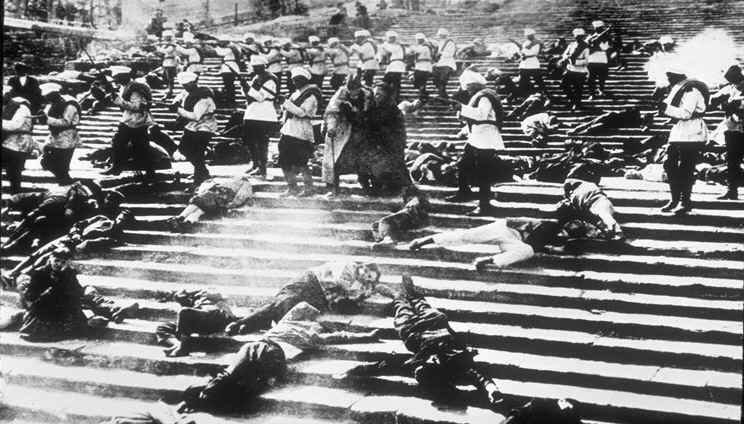
The most celebrated scene in the film is the massacre of civilians on the Odessa Steps. This scene has been described as one of the most influential in the history of cinema, because it introduced concepts of film editing and montage to cinema. 

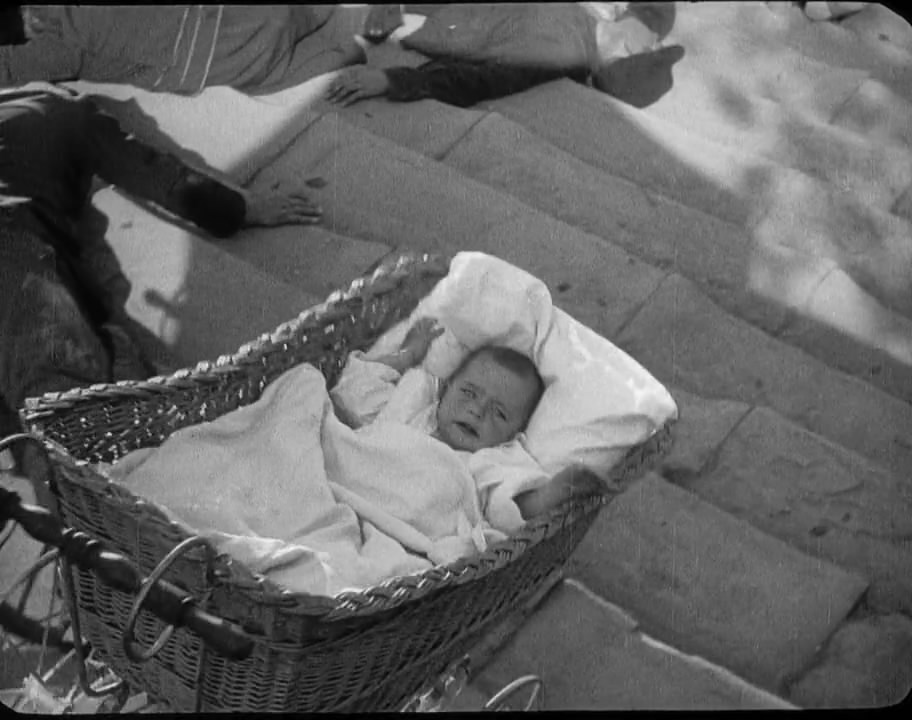
In this scene, the audience experiences emotional intensity through movement and editing. Once can notice the close-ups of the people rushing chaotically down the steps as they see the soldiers marching down towards them. The implication of rushing movement is also shown through the long shots of the same scene. The chaotic movement is superseded by the soldiers rhythmically marching down the steps. The effect is also enhanced by the increase in tempo and the accelerated rhythm of the music. There is a reversal of the downward movement and this is seen by the slow and solemn movement of the woman as she carries her dead child up the stairs towards the soldiers. Once the woman is shot, the focus goes back on the crowd rushing downwards. The scene ends with a slight increase in rhythm and tempo as the focus becomes the baby's carriage rolling down the steps amidst the fleeing crowd.


A wide shot of the massacre on the 'Odessa Steps'


The boots of the soldiers shown
marching down the 'Odessa Steps'


A baby in a carriage falling down the 'Odessa Steps'


References:

Micheal McVey, 2010. Montage and Juxtaposition in “Battleship Potemkin” – Odessa Steps Sequence [online] Available at <http://skiffleboom.wordpress.com/2010/05/06/montage-and-juxtaposition-in-%E2%80%9Cbattleship-potemkin%E2%80%9D-%E2%80%93-odessa-steps%C2%A0sequence%C2%A0from%C2%A0michael%C2%A0mcvey-skiffleboom-com/> [Accessed 28th October, 2013]


Image sources:

http://upload.wikimedia.org/wikipedia/commons/6/67/Potemkinmarch.jpg

http://upload.wikimedia.org/wikipedia/commons/e/e2/Odessastepsboots.jpg

http://upload.wikimedia.org/wikipedia/commons/0/0b/Odessastepsbaby.jpg


Video source:

http://www.youtube.com/watch?v=Ps-v-kZzfec

Tuesday, 15 October 2013

Changeling

Cinematography: camera movement, angles and shots


Let's face it: no matter how much we deny it, at some point or other we all gave in to the little voice in the back of our minds controlled by a little devil (or not) by the name of curiosity. Many a time have we watched a film purely based on an intriguing title. Well, that is exactly what happened to me this time round. 

Directed by Clint Eastwood and featuring the flawless talents of Angelina Jolie, Changeling is set in Los Angeles in 1928. The film, based on real events, is about a single mother - Christine Collins (Angelina Jolie) - who returns home from work one day to find that her five-year-old son Walter Griffith is missing. When she files in a report, the LAPD are not too eager to help a single mother. Five months later Christine is reunited with her son, only to find out that he is an imposter. When she points out that the child is not her son, Christine is faced with accusations that she is a liar, an unfit mother. Despite the effort of the police, a doctor and the boy himself to convince her, she continues to fight to find her real son. When she joins a minister in his public criticism of the police, she is sent to a psychopathic ward to silence her. Christine plans to show the LAPD for what they really were. She succeeds but still does not find Walter. Later she finds out that he was part of kidnapping and murder case, but he was one of the lucky ones to get away. This gave Christine hope to continue looking for Walter. In a nutshell, this film is a pure example of police corruption, female disempowerment, child endangerment and the consequences of violence. 

The emotion of the characters is essential to set the mood for each particular scene in the film, and this is effectively done through the camera shots and angles. 


For example, in the beginning of the film, when we can see the interaction between Christine and Walter, the camera angle is directed upwards, to show that the child really did look up to and love his mother. The same can be seen when the mother looks down to her son. The feelings of affection, warmth and love can be seen through the lighting used in these particular scenes. 


In other scene of the film, such as when Christine found out about her missing son and when she was taken to the psychopathic ward, the camera would zoom in on her face to show her tears and facial expressions so that the viewer could also feel the emotions along with the characters. 


The camera angles and choices also showed dominance between the LAPD and Christine. When the police and Christine were in the same scene together the cameras angle seemed to be an upward angle toward the police and a downward angle toward Christine to show the police had dominance over her and all other females.


With regards to camera movement, we can see they were not fast-paced unless it was a scene full of suspense. The camera angles and choice of shots were more slow and steady to show emotion and realism of the situation that was happening to Christine. 

In my opinion, Clint Eastwood did a brilliant job on the film since despite the effective, simplistic acting of the actors, the light and shadowing, scene selection and camera angles were excellent in capturing the attention and heart of critics and viewers alike.